There are already a number of ads about the dangers of texting and driving. Well, they're not really ads. They're not advertisements, and I doubt they've ever changed the way anyone has ever approached their lives. In fact, the stupidity of these propagandist commercials almost makes me want to text and drive just to show it's possible. Anyway, prepare for a whole new slew of propagandist commercials about not texting, smoking, and walking around cliffs.
That seems awfully specific, doesn't it? Well, there's a reason. In Alaska on September 17, Maria Pestrikoff (pictured right) was doing all of these naughty things at once. As it turns out, she lives near a 60 foot cliff. Of course, you know how it goes when you're comfortable in your neighborhood. Demonstrating what she found to be successful multitasking, Maria popped a cigarette into her mouth, lit it, and began to text while she walked to her house.
A problem showed its ugly head, however, when she wasn't watching where she was going and her natural sense of direction led her astray. Rather than walk directly to her house by the time she was finished with sending her text message, she ended up falling off the 60 foot cliff. She ended up stuck between the rocks and the tide at the bottom of the cliff, injured. Of course, the plus side to perpetually keeping a kung fu grip on your phone is that, when you plummet 60 feet to a rock bed when the tide is coming in, you've got a handy dandy way to communicated with 911.
The tide was just at her toes when the authorities arrived and brought Maria to the hospital, where she is now in a stable condition. So, there's the true story with a big moral. Don't text, smoke, and walk near cliffs at the same time.
It almost sounds like one of those DirecTV commercials, doesn't it? When cable goes out, you start smoking. When you start smoking, you start multitasking more. When you start multitasking more, you text and smoke at the same time. When you smoke and text at the same time, you fall off a cliff. Don't fall off a cliff. Get rid of cable and get DirecTV.
Writer/director Paul Thomas Anderson is considered about the cream of the crop of modern filmmakers. He's often referred to as The Next Stanley Kubrick even, which is, as far as I'm concerned, a silly statement. PT Anderson is one of the freshest, most talented voices in cinema, but he has certainly developed his own voice. He's not the next anyone, he's PT Anderson. As a cinematic master, he last graced cinemas with his magnum opus, There Will Be Blood five years ago. Now, he's back with a film that has a similar intensity not present in his earlier work. PT Anderson returns with The Master, and period drama shot on 65mm film that is every bit as captivating as its predecessor, if not quite as satisfying.
That's not how a film should be reviewed, though, is it? On so many sites, I see this film getting downgraded simply because it's not There Will Be Blood 2. The simple truth of the matter is The Master is a very, very different film from Blood. They share a few stylistic things in common, but in the end, here we have a much more intimate and smaller story about troubled people. It's not about huge character arcs or a complicated story; it's a glimpse into the lives of these flawed individuals.
Our protagonist is Freddy Quell (Joaquin Phoenix), a man returning from WWII with Post Traumatic Stress Disorder who is attempting to have a normal life, only that's not as easy as it seems. His mind is very messed up now, presumably a result of his devotion to the nation by serving in the war. Now, he cannot hold a job, has a major drinking problem, and has no direction in his life. One drunken night, he wanders aboard a yacht where he meets Lancaster Dodd (Philip Seamour Hoffman), the founder and head of a new religion known as The Cause. Dodd and Quell are opposites - a driven man who has devoted his life to leading others, and a seemingly hopeless drunk with no prospects or friends. The two become dependent off of each other, which leads to unexpected outcomes for the both of them.
It's best to leave the plot description vague because the plot itself is rather vague, not in an ambiguous sense, but rather because this is no more than a character study about complicated characters. What's perhaps the most fascinating decision behind the scenes here is how PT Anderson scaled back his filmmaking style quite a bit, moving the camera infrequently and avoiding the huge tracking shots he's known for. This is not to say that the cinematography was anything less than stunning, however. There is a strong style, but a much more subtle one than we've come to expect from the man. This subtlety also extends to the development of our two main characters.
From the script alone, these characters are developed to a point, without revealing their full complexities, which is where the absolutely flawless performances of Phoenix and Hoffman add considerable complexity to the characters. Anderson made an interesting choice; he let the performances create the complexity, and he just let his direction serve what was necessary to watch these two completely believable actors do what they needed to do. In a smaller role, it's also necessary to point out the amount of power Amy Adams brought to her role as Dodd's wife Mary. Unlike the other two, she has no scenes where she loses her calm or gets to be completely unhinged, but the subtleties of fantastic acting tell us quite a lot about who this woman is and why she's here.
Of course, if you've read any other reviews for this film, you're probably wondering why I'm not going off about how amazingly complex and hard to understand this film is. Honestly, I'm not sure if I'm dull but The Master doesn't come off like a terribly cryptic epic at all to me. There is symbolism and great thematic work, but none of it is terribly complicated. There are a few things that leave room for interpretation, but this is not a puzzling watch. One thing I've certainly taken away from it is how little respect Paul Thomas Anderson seems to have for religious institutions. Between this and his previous film, we see despicable men running religious groups to serve their own egotistical purposes, because they want to rule, spirituality in both cases is not even present. Here, we see this very blatantly, and even get the metaphor of a dog and his master through Freddy and Dodd as their relationship develops.
Paul Thomas Anderson has described this film as a love story between two men, but I really think it's just a tragic tale of a man who does not have the function of being normal who wants to fit in. We see the characters in The Cause partaking in their makeshift family because it makes them feel good to fit into something that's bigger than themselves. Characters see (or invent) meaning in the universe for a sense of belonging, but Freddy's mental state makes him stick out even from this basic opportunity. This is a tragic, intimate tale that's remarkably well put together and something that will no doubt improve with age.
I can't recommend this little film enough; it's one of the best of the year and a truly great experience. Sleepwalk With Me is currently playing on limited screens in the US, so get to it if you have a chance. Unfortunately for this site, my official review has been published over at WhatCulture!, but thanks to the handy dandy links here on the internet, I can bring it right to you!
Tom Knoblauch and Matthew Wurstner have recorded the very first episode of the Guilty Pleasures Podcast. We're still working out a few kinks, so the audio isn't perfect, but that should be perfected in the future episodes.
Click on the links to download an MP3 and enjoy! Each link is 30 minutes long, courtesy of Spreaker Online Radio. Download Part One: We discuss upcoming films and what IMDB considers the worst film of all time. Download Part Two: Should we legalize marijuana? How religion affects societies. Oh, and Jesus may have been married. Download Part Three: The 2012 election - what's wrong with politics today?
Come back and check every Tuesday evening for the brand new podcast.
UPDATED: Okay, sorry. False alarm. The party is over. The party pooper here is none other than writer/director Christopher Nolan who has confirmed that he has no plans to assemble a longer cut, regardless of how much better the film would be as a result of it. So, don't bother reading this article. There are better things to do (and better posts to read).
Mark Twain once said, "Politicians are like dirty diapers; the need to be changed often and for the same reason," although seemingly childish, the man might have a solid point. For so many years, politics have been a battle of the right and the left, Democrats and Republicans, Liberals and conservatives, but honestly putting all the media has told us aside, what do the essentials of politics boil down to?
So many people in America often times never take the time to study politics themselves and become familiar with the issues at hand. According to Peoplepress.org approximately 25% of Americans believe that what happens in Washington does personally affect them. That's 1 in 4 Americans.
Another ironic fact is that, while about 90% of Americans are registered to vote, only 53% consider themselves well versed on the relevant political topics. That means that almost 38% of registered voters are at the polls to fill in the boxes, slap on a "I Voted Today" sticker, and walk out the door. So you might ask yourself: what could they possibly be doing at the polls? They are simply voting with their party's choice, many Americans will simply vote with whatever party they have always voted for. Its gotten to the point where Politicians can count on certain states voting for them; for example, the south has always been called the solid south for their solid history of voting Democrat, thus the Democrats can count on solid votes from that region.
If you want to know an example of what I consider to be a perfect series, look no further than the dynamic duo of Before Sunrise and Before Sunset. I seriously adore these two films about love. Perhaps that's part of their genius. They are very much about love, though not exactly love stories. It's the tale of Celine and Jesse, who spend one night together in Vienna after making a rash decision as strangers to see how things went. Both young, they spend the night and fall for each other, but still don't know if things can last. The sequel picks up nine years later when they happen to meet again in Paris at a book signing. They spend a couple of hours reexamining their flame and what it might mean now.
In the end, the two were brilliant companion pieces following these characters in two days over the course of a decade. By the end of Before Sunset, I was amazingly happy and completely satisfied. As far as I'm concerned, that's one of the best endings to any film, especially any series. Did I want more? No. Hell no. There are some stories that are too perfect to be tampered with; this is very much one of them. The original mystique of a sequel to Before Sunrise provided a tricky but ultimately intriguing idea - what happened to these two? Are they together? Are they strangers? Did their brief love last? The sequel answered these questions magnificently while also provided a very telling look into Celine and Jesse's more mature, older selves.
“You know that guy who can pick up any girl, I’m him, on crack.”
This charming quote comes from Thank You for Smoking’s Nick Naylor, which he uses to describe his borderline arrogant, yet very attractive personality; however, I believe that there is a certain other endearing fictional character whose suave, persuasive power, and dash can be even greater summed up by this line: Mad Men’s chief character, Don Draper.
Don Draper is a stylish, highly complex alpha male that works as an ad man on Madison Avenue, in 1960s Manhattan. He’s no ordinary “Mad Man,” however. He is the head of creative at the Sterling-Cooper agency. The show, Mad Men, is an incredibly excellent program, and I highly recommend it. Its portrayal of the 60s office is wonderful, drenched with booze soaked offices, hard liquor business lunches and dinners, men and women lighting up all over the workplace and home, and just a general boys-will-be-boys mantra. Its characters are complex and deep, and their struggles not only reveal something philosophical and emotional about the 60s, but about America in general. If you have not had the pleasure of viewing this show (and plan on doing so), I implore you to stop reading this. As the warning above alerts, I will divulge details of the plot and characters within the show in my attempt to answer a certain question about Mr. Draper that I’m sure has been debated about amongst the show’s audience: Is Donald Draper a coward?
As much as I’d love to rattle off an ode to Don, something I may just do, praising the way he handles his business and his other various conquests (women, booze, etc.) I want to deal with this certain issue within his character, because despite his charm and skill, this issue of cowardice is something that cuts deeper into his true identity. I will be examining his character but only within the parameters of whether or not he is a coward. This is not going to be a post dedicated to extrapolating whether or not Don Draper is truly a good person, if he is as full of shit as people like to imagine advertisers as being, or even what makes him tick. The one, true purpose of this post is to reach a more solid understanding of his seemingly cowardly acts and to decide if he is indeed a coward.
To have a concrete reference point in this undertaking, I have turned to Merriam-Webster’s online dictionary for a definition of the word “coward.” They define a coward as, “One who shows disgraceful fear or timidity.” I think this is a fair enough definition, and the place to start my inquiry. There are several instances in the show, as well as underlining elements to Draper’s character that display what could be contrived as cowardice. I will highlight these examples, as well as examples of Don’s behavior that are equally as powerful but show bravery and strength. After this juxtaposition, I will try and arrive at my own conclusion, but of course, everyone has their own opinion.
Perhaps the most profound example of Don’s potential cowardice was his desertion from the Korean War, switching his identity from his birth name of Dick Wittman with that of his deceased commanding officer, Donald Draper. There are a couple of reasons as to why he did this, to escape the Korean War or to escape the poverty and depressing life that he had lived up to that point. He was a bastard son, his mother being a whore died in childbirth. His father, whom he lived with for the first years of his life, died when he was very young; his father’s wife then raised him along with her new husband in a depression ridden land. The other reason is that he was trying to escape the dangers of war in Korea, with his commanding officer being killed right before his eyes. I believe that it is more the former because all of the flashbacks that we see from his childhood show a very gloomy, empty existence.
Another of his cowardly acts was his attempt to try and run away from his problems. First it was with Rachel Menken, one of his several affairs throughout the show, after another employee, Peter Campbell, who has a peculiar almost jealous fondness for Draper, finds out the truth about Don’s past. He’s trying to flee from his problems, a classic example of cowardly behavior. For this, I have no defense because that truly is an example of bowing into fear and timidity. This motif of trying to run away from problems also manifests itself when Don travels to California with Pete to try and get in on the aerospace boom. He takes off with a woman he meets and leaves Pete and everyone else completely clueless as to his whereabouts. This running away is cowardly, true, but perhaps it is more selfish than cowardly. However, there is a great deal of selfishness within cowardice.
The most searing form of his cowardice was how he dealt with his half-brother Adam, when Adam, long convinced that he saw Don in the train all those years ago when they dropped off the real Don Draper’s body to Dick Wittman’s surviving family, discovers him in New York. Adam is thrilled and feels complete at finding his long-lost brother, whom he viewed as a hero and loved unconditionally. Don, however, is terrified and cold, wanting nothing to do with his brother. He offers him money, but rebukes his attempts to become a part of Don’s life again. His fear has crippled him, and a distraught Adam hangs himself in his hotel room, a victim of Don Draper’s fear.
Don does have many redeeming brave qualities. The way that he handles his business, his confidence and strength in pitching his advertising ideas has lead him to where he is in the show, and he continues to make bold presentations. Even the way in which he gains employment at Sterling-Cooper, as brought to life through Roger Sterling’s flashback, shows an eager, unapologetic, and unafraid young man trying to make his way up. He also shows a great courage in his constant aid of the real Don Draper’s widow, who discovered his lies when he was younger. He sends her money and visits her, letting her call him Dick, a name filled with so many painful memories.
To put it simply, Don Draper is a wonderfully crafted and complex character. The creators and writers of Mad Men have created a seminal character, a television role so human. He makes mistakes and does brilliant things, loves his children, cheats on his wife, etc. I can’t let myself keep going on because I wanted to limit my scope to his fear, to his potential cowardice. So after this contemplation, I ask myself and you all who have trudged through my rambling prose: Is Don Draper a coward? I must say that I do not think he is a coward. The character flaws within Mr. Draper, or Wittman, or whatever, are not due to cowardice. I believe that his personality defects must be labeled something else, perhaps selfishness, but that is a matter for another day. I think I would like to revisit that, but the answer to that question may seem a deal more obvious because his actions do speak louder than his words.
Do any of those guys in Ghillie suits look like Bigfoot to you? Well, apparently these camouflage outfits looked just odd enough for one man to attempt to create a Bigfoot hoax in it. That man is, well, was Randy Lee Tenley. Tenley was walking around the Montana woods in this suit on Sunday night and then decided to take things a bit further.
You know how, in those Bigfoot shows, the people talk about the creature walking across the highway in the night? Since it's night, they don't get that good of a look at the thing, but they can tell it's no ape and it's no man. Well, that's exactly what Tenley was hoping to achieve when he walked out onto Highway 93, only to get a drastically different outcome.
First, he was hit by a 15 year old (imagine being 15 and having nearly no experience driving when some weirdo in camouflage runs out onto the road), and then was thrown into the road where a 17 year old proceeded to run him over. "He probably would not have been very easy to see at all," said state trooper Jim Schneider.
Tenley's intentions were later confirmed by one of his companions, though, curiously, the Montana people are pretty intelligent. The local Highway Patrol claims to have received no calls about any strange sightings. I suppose time will tell whether any really happened - because we'll probably see someone interviewed about this on some show at some point. At some point, they may have even come onto our radio show.
All this Bigfoot stuff helps justify my ever growing disbelief at the subject. This site has received more than one false scoop about the release of crucial Bigfoot information, and this is not something I intend to fall for again, no matter what Bigfoot Organization you belong to. All that being said, I think this story is damn funny.
All you kids reading, don't try to be Bigfoot. Or, if you must pretend to be Bigfoot, look both ways.
Brick Tamland has been debunked by the National Park Service in the very well researched (and hilariously titled) study Bears and Menstruating Women. It turns out that the average menstruating woman does not need to fear bear attacks. This whole business started in 1967 when two women (allegedly on their periods) were attacked by Grizzly Bears in separate incidents. Thus a rumor was born that science would not test until the 21st century.
The study placed human menstrual blood in front of a variety of bears and tested their reactions. Grizzly Bears and Black Bears were generally uninterested in the tampons offering blood from a variety of stages of menstruation. The Grizzly Bear data is slightly more iffy, but they found no reason to think there is any correlation between the attacks and the periods. So, if you're camping in the usual sense of the word and you're on your period, you really aren't in any more danger than anyone who might not be on their period (or a man).
The Van Buren Bears
Of course, there was one interesting correlation that does appear to exist. . . It turns out Polar Bears were offered seal blood, regular human blood, and human menstrual blood and they reacted most strongly to the menstrual blood. The Polar Bears were significantly more attracted to the menstrual blood than the other offers, even ignoring the regular human blood and unused tampons. So, maybe there is some reason to fear if you're going to be around Polar Bears. I guess Brick won that point, though I think we can all agree that's not what he was yelling about.
The study concluded that humans with food are (generally) the biggest risk, not women on their periods. This was what attracted the average bears the most. If you run into a bear, the National Parks Service offers five nuggets of wisdom:
You can reduce the risks by: 1) hiking in groups of 3 or more people, 2) staying alert, 3) making noise in areas of poor visibility, 4) carrying bear spray, and 5) not running during encounters with bears.
And, though they supply ample evidence that you need not fear bears while menstruating, there are some precautions women ought to take anyway:
1. Use pre-moistened, unscented cleaning towelettes. 2. Use internal tampons instead of external pads. 3. Do not bury tampons or pads (pack it in - pack it out). A bear may smell buried tampons or pads and dig them up. By providing bears a small food "reward", this action may attract bears to other menstruating women. 4. Place all used tampons, pads, and towelettes in double zip-loc baggies and store them unavailable to bears, just as you would store food. This means hung at least 10 feet above the ground and 4 feet from the tree trunk. 5. Tampons can be burned in a campfire, but remember that it takes a very hot fire and considerable time to completely burn them. Any charred remains must be removed from the fire pit and stored with your other garbage. Also, burning of any garbage is odorous and may attract bears to your campsite. 6. Many feminine products are heavily scented. Use only unscented or lightly scented items. Cosmetics, perfumes, and deodorants are unnecessary and may act as an attractant to bears.
The Possession, a film produced by horror master Sam Raimi and claiming to have basis in fact, comes out this Friday. It touts an interesting premise, and an actually unnerving trailer. There are, for some strange reason, a myriad of exorcism or possession type films that come out every single year. It's difficult to think of any that were actually good, save for maybe the original The Exorcist. That was a little bit different, however, as no one had ever seen anything like it before. Now, we get it all the time. Of course, the concept of demonic possession is a wonderfully creepy idea and the fact that it could be real does a number on a lot of people. The problem is, even though nearly all of these films pretend to be based on a true story, they never get you to actually believe in what you're watching.
There's the trailer for The Possession, and it works. Well, I'd say. It both creeped me out when I saw it on the big screen and made me curious to see the whole story. That's an accomplishment of its own for a PG-13 horror film these days. But there was one thing about the trailer that didn't sit well with me. There was something that clearly wasn't supposed to be there: the phrase "Based on a True Story." As interesting as the film looks, I really doubted any of that happened. So, I decided to look it up for myself.
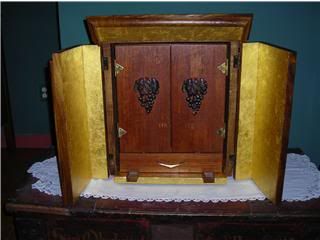
The source material is a book by Jason Haxton titled Dibbuk Box, chronicling his personal struggle with the strange box. I haven't read the book, but from excerpts that are available online, the story sounds spooky, but not anything like what you saw in the above trailer. It follows the strange happenings of a man who purchased a strange wine cabinet at an estate sale. He was warned that it was a dibbuk box, but he didn't know what that meant and bought it anyway. Here's some of the strange tale:
"At the time when I bought the cabinet, I owned a small furniture refinishing business. I took the cabinet to my store and put it in my basement workshop where I intended to refinish it and give it as a gift to my mother. I didn't think anything more about it. I opened my shop for the day and went to run some errands leaving the young woman who did sales for me in charge.
"After about a half-hour, I got a call on my cell phone. The call was from my salesperson. She was absolutely hysterical and screaming that someone was in my workshop breaking glass and swearing. Furthermore, the intruder had locked the iron security gates and the emergency exit and she couldn't get out. As I told her to call the police, my cell phone battery went dead.
"I hit speeds of 100 mph to get back to the shop. When I arrived, I found the gates locked. I went inside and found my employee on the floor in a corner of my office sobbing hysterically. I ran to the basement and went downstairs. At the bottom of the stairs, I was hit by an overpowering unmistakable odor of cat urine (there had never been any animals kept or found in my shop). The lights didn't work. As I investigated, I found that the reason the lights didn't work also explained the sounds of glass breaking. All of the light bulbs in the basement were broken. All nine incandescent bulbs had been broken in their sockets, and 10 four-foot fluorescent tubes were lying shattered on the floor. I did not find an intruder, however. I should also add that there was only one entrance to the basement. It would have been impossible for anyone to leave without meeting me head-on.
"I went back up to speak with my salesperson, but she had left. She never returned to work (after having been with me for two years). She refuses to discuss the incident to this day. I never thought of relating the events of that day to anything having to do with the cabinet.
"Then, things got worse."
There are more passages describing recurring nightmares and various other strange events including shadows traveling around the man's house. It's all quite unnerving if it's real, which is exactly what it is supposed to accomplish. If I were to read the allegedly true account of this man in his book, I'd no doubt be scared or laugh it off. One or the other. The movie, however? There's no similarities at all. So, why even bother saying it's based on a true story?
I ask you, the audience, are you ever more frightened of an insane horror movie because it claims to have some basis in fact? The most famous example of this is, of course, The Exorcist. It's an unnerving film for a lot of reasons, and people were positively terrified that any amount of it could be real. The story of that film, based on a novel, follows a young girl who begins to act strange as she has been allegedly possessed by the devil. Subsequently, an agnostic mother calls upon two priests to come try to cure her daughter. Things get seriously insane over the course of the film, however, and it's hard to believe it was real.
So let's look at the "true story" that inspired The Exorcist. First off, it was a boy in real life, not a girl. A lot of the novel was inspired by the diary of a Reverend involved in the exorcism. The accounts say things began when a picture of Jesus began to shake in the house where the boy lived, then strange scratching noises continued to perplex the family, as well as sounds of squeaking shoes at night. Vaguely around this time, the boy's Aunt Tillie had introduced him to a Ouija Board, and soon after she died. During the exorcism, there was some evidence to suggest her death was connected. The boy's bed began to shake and things in the room would move on their own.
The family called upon two Lutheran ministers to come see the boy. Psychologists and parapsychologists were continually running tests on the boy but could find nothing wrong with him. Scratches and bruises began to appear on the boy, and the scratches even manifested in the form of letters, spelling words. He was moved to a hospital where a priest was brought in to bless the boy. During this, the boy kicked, yelled at, and even cut the priest with a loose spring from his bed. The priest went on to have a nervous breakdown.
Eventually, a legitimate exorcism happened, during which the boy became so violent that they had to hold him down. He spoke in different languages and vomited on the priests. After many exorcisms, he claimed that the demon inside him had been expunged by Michael the Archangel and slowly things returned to normal.
If you ask me, the true story here is much scarier than the movie. There are quite a number of other films where I think the reality is much scarier than what ended up on the screen. Another famous example is Psycho, a film that terrified audiences like no other. In truth, it's a wonderfully crafted film that keeps you on your toes throughout its entire runtime. What was the real story?
Ironically, the real story behind Psycho is more along the lines of The Silence of the Lambs, a horror film that didn't claim to be based on a true story. It was similar to the film, a man was killing people in his hotel, as well as digging up corpses that reminded him of his dead mother. He would skin the bodies and make lamp shades as well as a woman-suit out of them, so he could be a woman himself. He ended up in a mental institution for life. Honestly, I like Psycho just fine as it is, and this was very much what Jame Gumb of The Silence of the Lambs was doing.
This brings us back to my original point, however. With the way horror movies love to throw around the phrase "Based on a True Story," I feel like The Silence of the Lambs has just as much of a right to say this as The Exorcist. Both originally come from stories that share some basic similarities in real life, but are heavily adapted for the big screen. This has been used for films like The Serpent and the Rainbow, The Hills Have Eyes, The Mothman Prophecies, and An American Haunting to name a few, but did it really scare audiences any more than if they'd just focused on telling a compelling scary story?
I believe scary fiction can be even more frightening than true stories for a simple reason - there are no rules. Anything could happen. When I see something like The Rite and things get too ridiculous to be true, I stop being scared because I know it's based on a true story and we've deviated quite a lot. When I read a Stephen King novel, I have no idea where things will go, and that's part of the fun. He has full license to make things as crazy and unpredictable as he likes and it works a lot better.
On the other end of the spectrum, the true accounts of these horror stories is often much creepier. It wouldn't surprise me one bit if the Dibbuk Box book turns out to be a much scarier experience than seeing The Possession. Truth can be stranger than fiction, but I like there to be a legitimate distinction. I'll be very surprised the one day an exorcism movie comes out that's actually related to any form of reality, however.
I assure you, we used all this scientific mumbo jumbo to configure each one of these.
Virgo (8/23-9/22): You enjoy being the sidekick or indispensable assistant. This year, knock it off. Libra (9/23-10/22): You're indecisive, avoid confrontations, and carry grudges. This year, get in a fight. Scorpio (10/23-11/21): You're passionate, intense, and probably muscular. This year, find a worthy adversary. Sagittarius (11/22-12/21): You're unemployed and probably an alcoholic. This year, knock it off and get a job. Capricorn (12/22-1/19): You're a condescending know-it-all and probably really annoying. This year, knock it off. Aquarius (1/20-2/19): You're boring. This year, knock it off. Pisces (2/19-3/20): You tend to be a victim, fearful, overtrusting, and sad. This year, knock it off and grow some balls. Aries (3/21-4/19): You're courageous, have an athletic body, and everyone hates you for it. This year, knock it off. Taurus (4/20-5/20): You're stubborn, uncompromising, and possessive. You also seem like a fat ass. This year, knock it off. Gemini (5/21-6/20): You have scattered energy in too many places at once, are nervous, and have a short attention span. This year, get treated for ADD. Cancer (6/21-7/22): You're manipulative, you cling to the past, you're insecure, and you're a pack-rat. . .but you probably have prominent breasts. This year, knock it off (unless you're a woman, then the last part is okay). Leo (7/22-8/22): You're an asshole; you're constantly arrogant, stubborn, inflexible, and lazy. This year, knock it off.
As foretold by Arena Govier and Tom Knoblauch