Showing posts with label Film. Show all posts

Sunday, January 27, 2013

Review: A Glimpse Inside the Mind of Charles Swan III


The mentality following the termination of a serious relationship has been the subject of countless pieces of art, but two films really brought film to new levels on the topic. Those films were Annie Hall and Eternal Sunshine of the Spotless Mind. In both cases, you got a well developed sense of the internal despair of a hard breakup and the mental inability to stop analyzing and going over what happened, what was right, and, ultimately, why it all came tumbling down. Charlie Sheen returns to theaters for the first time in nine years in Roman Coppola's A Glimpse Inside the Mind of Charles Swan III. Coppola's most recent cinematic efforts include co-writing the screenplays for Wes Anderson's The Darjeeling Limited and Moonrise Kingdom. Here, he attempts to add another story to the genre so incredibly well defined by Annie Hall or Eternal Sunshine.

Charles Swan III is a rampant womanizer, but he has been with a woman that he has really fallen for, but she has broken up with him following her discovery of a drawer filled with dirty pictures of his past girlfriends and hookups. Now, he is devastated and falling behind in his work as a graphic designer. Rather than deal with the issues, he is both stuck in the past and his fantasies of both the world and how the past could have worked. The film feel surreal from frame one, and never really gets to a point where the stylized universe it is set in is differentiated with some sense of reality. This style walks a fine line between style and substance. Woody Allen showed in the 70s how the two can actually mesh quite will. Roman Coppola, unfortunately, does not pay the same amount of attention to developing his characters as he does to their costumes or the soundtrack.

Saturday, January 12, 2013

The 2013 GP Movie Awards

Well, the Academy Award nominations have been announced. They're sort of underwhelming this year, so here is my alternative. Welcome to the First Annual Guilty Pleasures Movie Awards. Here are the nominees with the winners in bold. Feel free to agree or disagree in the comments below. I'm sure my choices have just as much potential for disappointment as that group of old white men's.

Before we go too far, let me point out that our poll for what you, our readers, would have nominated for Best Picture has concluded with the following ten nominees: Argo, Moonrise Kingdom, Zero Dark Thirty, The Hobbit: An Unexpected Journey, The Avengers, The Dark Knight Rises, The Master, Skyfall, Lincoln, and the overwhelming number of votes went to Les Miserables, which we can claim as our victor for the reader awards.

Now, it's my turn.

Thursday, January 10, 2013

My Favorite Films of 2012

It's the end of the year, and thus time for the Best Of lists. Seeing as I live in Omaha, Nebraska, I'm stuck with the unfortunate reality that no one here has seen Zero Dark Thirty and won't until mid-January, so that will not be eligible for this list. Other than that, it's pretty simple. This year, I had a very unique challenge when putting together this list. It was honestly very difficult to think of ten films from 2012 that I have passion for. As someone who sees hundreds of movies a year, it made me sad to think that we had such phenomenal filmmakers like Wes Anderson, Quentin Tarantino Whit Stillman, Woody Allen, Christopher Nolan, Paul Thomas Anderson, and many more all contribute to the year, only to find that most couldn't create the classics we expected. So this list is five films I liked, three films I really liked, and two that I loved. That's all I could muster. Let's hope 2013 goes better.

Top 10:


10. Seeking a Friend for the End of the World

Right way, I've probably lost some readers with this choice. No one seems to like this movie. I absolutely expected to hate it. Quite frankly, the previews for this looked dreadfully bland, as opposed to biting like the premise suggested. That being said, though this was not nearly as dark as I anticipated, I found myself frequently moved by its poignant emotional core. Steve Carrell and Keira Knightley gave surprisingly restrained performances, letting depth sink in in a much more realistic way than you would think.  The jokes did tend to run a little more broad and silly than they needed to, but the emotions of the film were absolutely in the right place and it's ultimately a wonderful film.


9. Hitchcock

Admittedly, there are certain films that are not really made for general audiences. The average moviegoer today may have some idea of who Alfred Hitchcock was and what kind of movies he made, but few would see this movie and be as completely swept away by it as true cinephiles. That's really who this was made for and it hits all the great notes. It is a stylized biopic that may not strike the realism chord, but it paints a very entertaining picture of one of the most important genre revolutions in cinematic history. What if someone good made a horror picture? Witness the way Alfred Hitchcock brought horror into the A-Picture club and changed movies forever.

8. Django Unchained

I really struggled with where exactly I wanted to place Django Unchained on my list. I have very mixed feelings about it, but ultimately I think it is a very creative and unique movie. Maybe if it had come out months ago, I'd have enough time to really digest where it falls on a list like this, but I've only had a few weeks so I'm sorry. Quite frankly, I find the first half of this epic blaxploitation spaghetti western to be amazingly perfect cinema and some of the most entertaining work I've seen all year. Enter the second half, which is when Quentin Tarantino really let his trademarks take over in place of his western setting and things get a little bit more murky and less successful as things take a dark turn, followed by a silly over the top epilogue. Django is more of a mixed bag when looking at the sum of its parts, but 4/5ths of its parts are pretty dang wonderful. It's not the genius level of Inglourious Basterds or any of his 90s work, but there's enough to like here that this really deserved a place on my list.

The Most Disappointing Movies of 2012


This list deserves a disclaimer: disappointing is not the same word as worst. Every year, people call me out for my choices on this list by saying the film wasn't that bad. Well, yes, I realize that. There's only one legitimately bad movie on this list. The rest, to my great disappointment, are artistic misfires that had unbelievable potential. This potential led me to think I was in for masterpieces that. In most cases, these were movies I thought would be my favorites of the year. Instead, they ended up here.


5. Cloud Atlas

I never wrote a review of Cloud Atlas because reviews, while they are literal tellings of one's subjective reaction to a piece of art, are not supposed to be written exclusively as a reaction to the biases one had walking into a film. With Cloud Atlas, I wasn't just watching an inventive new film; I was eagerly anticipating the adaptation of one of my favorite novels of all time. I absolutely adore David Mitchell's groundbreakingly original novel. It just reeked of genius and after watching the five minute long trailer for the movie, I just started believing that they'd somehow pulled it off. Before seeing the movie, I purchased the soundtrack and once again let myself think My God, they've done it. Never before have I listened to a soundtrack for a movie based on a beloved book and felt that the composers perfectly captured the tone of the novel, but Cloud Atlas did it for me. At this point, I was convinced that the Cloud Atlas movie would be my favorite movie of the year, maybe of all time.

Then, when I saw it, reality finally settled in. It was always going to be extremely difficult to fit all the things that make Cloud Atlas work into a 165 minute long movie. In fact, I'd argue that it's impossible, as proven by the movie. This needed to be a 6 hour long miniseries on HBO to really work, and hopefully someday someone will give me many millions of dollars to make that happen. Today however, I'm left with this strange hybrid of the novel that made a lot of artistic changes that worked well for some of the stories, but butchered my favorite one. The structure of the original novel was a large reason for why its multi-layered story worked, but the film becomes more disjointed and ultimately works so fast that you fail to get attached to these characters or feel the gravity of the situations they are in. The film has some beautiful acting and cinematography but it turns out that it's just too much to ask for someone to create a broad, short version of the breathtaking novel. All that being said, I still listen to the soundtrack on a regular basis.


4. Seven Psychopaths

There was absolutely no doubt in my mind that Seven Psychopaths, Martin McDonagh's followup to In Bruges, was going to be great. After all, Bruges is such a perfectly woven film with perfect nuance and attention to all the details that this guy had exhibited none of the qualities of a one-hit wonder. The movie, however, suggests he may be just that. Rather than make a movie, we have a collection of characters and skits and vignettes that have potential but never really pull together because, as the writer's block inflicted protagonist will admit, there was never any direction when writing the script. It came from writer's block and is about writer's block, but fails to make any real points about the subject we haven't seen handled with much more subtlety in works like Barton Fink or Adaptation. The acting here was all superb, so it was really a shame that nothing ever came together in the end here. Oh well, at least we got Tom Waits holding a bunny.

Sunday, December 30, 2012

Django Unchained: Tarantino's Most Indulgent Film Yet


Only a handful of filmmakers have final cut rights in every contract they sign. What that means is that the financier or studio can make as many suggestions about what could be change or tweaked to the script, cast, or finished film, but the director has no obligation to listen to a single thing. In short, these directors have 100% control over what they're doing. As a concept, of course, this sounds like the ideal setup for making movies. After all, what do studio heads know about movies? They're businessmen, not artists, right? Quentin Tarantino began in the independent circuit and by the time his second movie (Pulp Fiction) was released to huge profits and acclaim, it was clear that this man was one of the rare artists who would forever get final say on everything he did from now on. In the beginning, he had final say over a series of low budget, low risk projects, but as the 2000s rolled around, the budgets grew increasingly higher and Tarantino became one of the even more extremely rare few who could make blockbusters and take no criticism from anyone giving him money.

Now, that is not to say there was no one giving him opinions throughout that time on how to improve his work, be it through pacing, what plots could be expanded on or taken out, or even music choices. From the very beginning with Reservoir Dogs, Quentin Tarantino got this valuable advice from a woman named Sally Menke, his editor. With Menke, Tarantino found a genius to shape his massive narratives into tightly woven, fatless products. That's not to say every project the two collaborated on was a masterpiece; I'd argue that their 90s work towers far above the post-2000 films with the exception of Inglourious Basterds. However, it was clear that Menke had the sensibilities that a studio head may not; she could take an objective look at what Tarantino made and turn it into the best product the story had the potential for. Tragically, Sally Menke died in 2010 at the early age of 56. A year later, Tarantino began work on Django Unchained, his most expensive project to date and ultimately his longest.

Friday, December 14, 2012

The Hobbit: Three Hours You'll Never Get Back Again


I'm not really big into fantasy. Let me get that out there straight away. That being said, I'm certainly a sucker for great storytelling, compelling characters, and narratives packed with more than enough story to justify a long runtime. The Hobbit: An Unexpected Journey exhibits none of these qualities. It is, of course, inevitable to compare this latest film to The Lord of the Rings, a trilogy that I hardly fawn over, but can appreciate. Middle Earth has never fascinated me, but with The Lord of the Rings, Peter Jackson showed that well cast and developed characters can certainly make you buy all the silly bits in the story. Certainly with those films you cared about the overall goal. In fact, the story was pretty simple: if that ring doesn't get destroyed, we're all going to die. Okay, sure. I get it, I guess.

Enter the horribly convoluted "plot" of this first in the Hobbit trilogy, a prequel taking place 60 years before the story we all know so well. Gandalf the Grey (Ian McKellan), feeling especially snotty, decides to barge in on Bilbo Baggins (Martin Freeman) with 13 oafish, uninteresting dwarves looking to reclaim their mountain home. The Lonely Mountain was the dwarf kingdom before a gold-craving dragon named Smaug came in and snagged it for himself. Apparently the dragon wasn't much interested in using the gold to buy things for himself, because he's taken to just sleeping under piles of gold as a hobby. So, why Bilbo Baggins? Well, these incompetent and stubborn dwarves don't really get it, and neither do I. The group begins the journey and encounters endless chase scenes where danger is constantly around the corner and no one can ever save themselves.

Tuesday, December 11, 2012

Watch the First Trailer for M. Night Shyamalan's After Earth

Here, Kitai Kitai.

Is there anyone out there who still heavily anticipates every new M. Night Shyamlan release? If so, this is the movie you've been waiting for since you apparently loved The Last Airbender. I'm working on a much longer editorial on the rise and decline of M. Night Shyamalan, so I'll save that for the next few days when that gets posted. Anyway, here's the plot description for his latest, After Earth:

After Earth is set one thousand years after cataclysmic events forced humanity's escape from Earth and Nova Prime has become mankind's new home. General Cypher Raige (Will Smith) returns from an extended tour of duty to his estranged family, ready to be a father to his 13-year-old son, Kitai (Jaden Smith). When an asteroid storm damages Cypher and Kitai's craft, they crash-land on a now unfamiliar and dangerous Earth. As his father lies dying in the cockpit, Kitai must trek across the hostile terrain to recover their rescue beacon. His whole life, Kitai has wanted nothing more than to be a soldier like his father. Today, he gets his chance.

That's right. The two main characters in After Earth are named Cypher Raige and Kitai. Now, onto the trailer!


After Earth gets released on June 7, 2013.

Monday, December 10, 2012

The Star Trek 2 Bad Guy Is. . .John Harrison?

(Left to right) Zachary Quinto is Spock, Benedict Cumberbatch is John Harrison and Chris Pine is Kirk in STAR TREK INTO DARKNESS from Paramount Pictures and Skydance Productions.

I honestly don't like Star Trek including the original series, the spinoff series, or the movie series, with one notable exception: Star Trek II: The Wrath of Khan. Really, that's a great movie. If I taught a film seminar about that really rare occurrence known as "good blockbuster writing," it would be absolute blasphemy to do anything other than praise the first Star Trek sequel. That one really understood what it is that makes big movies so dumb. Most franchise films have no sense of danger (of course no one dies, right?), bland characters/dialogue, and are predictable beyond belief. Khan throws all the cliches of an extremely cliche-filled series out the window and brings a balls-to-the-wall thrilling revenge story to the series that is not afraid to kill off anyone as the ruthless Khan makes things much more personal and series than you'd ever expect.

Last year, as J.J. Abrams' then-untitled sequel to his 2009 Star Trek reboot/reinvention/sequel thingy began casting, we had no information about the plot other than Benicio del Toro had been approached to play the villain. Well, it didn't take long to throw out a few reasonable guesses about what villain Abrams could possibly want another Latino actor for, especially a Latino actor with a resemblance to Ricardo Montalban. It's KHAN! Things were lining up for a sequel that could potentially bring the franchise back to its, well, only high point. My interest went from apathy to excitement in a second. Abrams is no dummy. I trust what would essentially be a remake of the great sequel to him. Then, del Toro could not agree on a price so he dropped out of negotiations, only to be replaced by a lanky British fellow - Benedict Cumberbatch.

Sunday, November 18, 2012

Lincoln (Or, Spielberg's Middle School History Lesson)


What do you know about Abraham Lincoln? In America, at least, middle school and high school tend to give off this mythical impression of the president that ended the Civil War and freed the slaves. There's generally some attention directed to the importance of the thirteenth amendment, as well as a basic understanding of the key players in the war. You know the generals, you know some of the politicians, and you know the political implications of Lincoln's actions. So, when Steven Spielberg announces he's making an Abraham Lincoln biopic starring Daniel Day-Lewis and a million other great actors, you're incredibly excited to see what the director of such biting true story films like Schindler's List or Amistad will bring to the table. At least, that was my reaction. This movie could teach me so much more about the depth of these incidents I've been learning about my whole life, right? Well, walking out of Lincoln, I honestly can't say I learned anything at all.

Does this mean Spielberg has failed to make a compelling film? Well, no, not really. In fact, there are parts of Lincoln that left me far more moved than I thought I would be and overall it does have a certain compelling quality to these historical scenes that are predictable, simplified, and ultimately tell you nothing new. The vast majority of the film details the courtroom drama of passing the thirteenth amendment to abolish slavery as the Civil War is moving towards closure. Spielberg introduces you to a wide variety of characters played by the likes of Hal Holbrook, David Strathairn, Sally Field, James Spader, and an absolutely wonderful Tommy Lee Jones. Each actor brings a great energy to their respective historical roles and helps bring them to life. The acting is often powerful and sucks your heart into the scenes that your brain is assuring you are silly in their overdramatization or oversimplification. Such is an issue I had many times throughout the two hour run time.

As far as the performances go, most are applauding Daniel Day Lewis for his effort, but I have to say this was one of the least impressive performances I've seen from him. Let me of course make the important distinction here that a not-as-impressive Daniel Day Lewis performance is still likely to be among the top ten performances anyone will see all year. What I took issue with was this high pitched voice Day Lewis affected for the role. In historical accounts, Lincoln was documented as speaking in a more shrill, high pitch, which Day Lewis does his best to create. It works for the most part, but his high voice never changes pitch and is never really able to capture emotion outside of inflection. Not everyone speaks at the exact same pitch at every moment with only volume and speed fluctuating, and every other actor demonstrates a wider vocal range than our title character. This certainly was a character, for its performance and the screenplay aren't interested in painting a flawed man. This is undoubtedly that mythical figure you've heard about since you were a child.

Who am I to say that Abraham Lincoln wasn't this fable-spewing social genius at all times? Well, I'm not to say that at all, but let me just say it didn't feel all too real. I'm not here to argue the history when something simply doesn't work in the film. These characters do their best to seem genuine when Tony Kushner's screenplay paints so many of them as simple caricatures. If you're a good guy, you show some mild range of emotions, are a Republican, and hate slavery with a burning passion. If you're a bad guy, you're a close minded Democrat who hates blacks. Lazy expositional writing keeps you constantly aware that you are, in fact, watching a scripted version of events that were probably not so conveniently constructed. If Lincoln was a play, its cinematic shortcomings might feel a lot more at home, but unfortunately, this is a freaking Steven Spielberg movie.

Where is the sense of shock at the depth of characters impacting history singlehandedly we were so wonderfully exposed to in Schindler's List and Amistad? Where is the bite this once great director was so famous for? Are we forever going to be stuck with these long, overly sentimental dramas like War Horse? What bothers me even more than just how safe Lincoln is was the moments where you can really sense Spielberg waking up and beautifully directing a scene to a well deserved impact. There are these great little moments in Lincoln that make you wish there was more to talk about, either historically or just in terms of his wide cast of characters. This should have been a thought provoking movie, but instead we are left with a simple middle school history lesson that would certainly bore the hell out of middle schoolers.

6/10

Sunday, November 11, 2012

Skyfall: Bond Goes Wrath of Khan


There are the occasional mainstream franchises that I absolutely adore. In most of those cases, I don't adore them by the time studios are finished with them, but there's some amount of love associated with the basic mythology and characters that carries into each new opus. Then, there are far more franchises I am either indifferent to or actively despise. The 007 series has been hanging around cinemas for 50 years now and I must confess I'm rather indifferent to the lot of them. I've seen a handful and yet none of them really left much of an impression. Most of them fell into the average category, with the only exception being Quantum of Solace, an embarrassment to all involved. That being said, Daniel Craig's more serious and realistic James Bond has always had a lot of promise to it and I went into Skyfall with the hope that the payoff I'd been hoping for since Casino Royale finally existed.

Skyfall is one of those movies that would no doubt play best to one who knew absolutely nothing about it, but for the sake of writing a review, I can't leave out all plot details. So here's my abbreviated paragraph giving you a small taste. MI6 is in trouble. A flash drive containing the names of every agent embedded in terrorist organizations around the world is stolen and released. Bombings target M (Judi Dench), the leader of MI6. James Bond (Daniel Craig), now the oldest agent in the organization is faced with the question: in the age of advanced technology, are field agents even necessary anymore when all this destruction can be caused with the use of a computer? Faced with a foe (Javier Bardem) unlike any of the traditional Bond villains with a personal vendetta and no grand conspiracy, and no fear of failure. This is truly a worthy adversary because, to use the old adage, this time, it's personal.

Wednesday, October 31, 2012

Halloween Movie Countdown #1: The Shining

Here it is: The Grand Daddy of Horror. The Shining may just be the best horror film ever made. That's being said with full appreciation for the divisive nature of the film. Most people fall into three camps when they watch The Shining: the first camp falls completely in love with it, the second camp is pissed off because writer/director Stanley Kubrick changed too much from Stephen King's novel, and the third camp looks at it and says, "This is boring." Well, there's a reason for all of those, but I clearly fall into the first camp. That's why I'm writing this, obviously.

Though a plethora of viewers saw the movie with the hopes that it would be just like the Stephen King novel came out disappointed, the entire setup still remains from the book. Both are about Jack Torrance, a man hired to be the caretaker of the Overlook Hotel during the winter months while the hotel is closed. He takes the job so he'll have more time to focus on writing. Along with Jack is his wife Winifred and his son Danny. Over the months of isolation, Jack begins to slip into madness - but is that simply cabin fever or something far more sinister?

The Shining is a slow burn, there's no mistaking that. The scares don't start until a significant way into the film, but right away Kubrick works his movie magic to create a very strong sense of tone. The eerie tone is created through music and symmetrical shots that, under a less seasoned filmmaker, would have come off cheesy. Here, they do the job wonderfully. You're almost on edge for a whole hour just because you know something is going to happen, but things can't go too quickly. This is not The Evil Dead. The isolation is not met immediately with evil killing forces. No, this is much smarter than that, and much, much better.

If you're looking for iconic horror imagery, you really need look no further than The Shining, a film far more influential to the landscape of cinema that most are willing to admit. Stanley Kubrick's attempt to make a mainstream film may not have completely churned out one, but it did continue to inspire techniques that would be utilized by films of all genres to this day. Of course, the easiest to point out is the use of steadicam for many of the tracking shots, most notably following young Danny Torrance on his tricycle through the hotel. This film is arguably the most influential horror movie of the past forty years. So many attempt to emulate the subtleties of this film to no avail.

In true Stanley Kubrick fashion, The Shining is a terrifying, disturbing experience, but that's not at all to say it isn't entertaining. If anyone could turn the story of a man turning dangerously insane into an entertaining 150 minute ride, it's Stanley Kubrick. The performances across the board are both realistic and stylized in a way that works far better than it should have. Jack Nicholson in particular turns in a performance that's terrifying yet has odd bursts of humor throughout the most intense scenes. This is truly a mad man you're watching.

This is a film that will not leave you for a long time. If you want proof of that, look no further than the hundreds of insanely detailed interpretations longtime fans of The Shining have come up with. Ask some - it's an allegory for the faked moon landing. Ask others - it's about the plight of the Native Americans. No, no, it's about the Holocaust. It's obviously about the cold war. Let me just ask - could it not simply be about the recurrence of evil in human nature? Whatever you think the film is "actually" about, it's going to get you thinking. That's really all that matters. If you want to look further into the very detailed interpretations of The Shining, there's a documentary coming out about it next year entitled Room 237 that seems worth a watch if you're into over-analysis of films. Who am I to say it's not really about secret knowledge Kubrick had about the faked moon landing?

Even knowing the outcome of the film, as most do, The Shining continues to be extremely effective for just about any viewing. I'm incredibly envious of those who got to see it in glorious 70mm this past summer in California. That'd be a dream come true, for as great as the film is on DVD, this is a film meant to be experienced fully in the cinema. That's true of every Kubrick film - they're intense, cerebral, immensely entertaining, and all of them are celebrations of the magic of movies. The Shining continues to disturb and entertain new viewers all the time, and if you're in a position where you can fit either category, you better go for it this Halloween. Trust me, these are words of wisdom.


Tuesday, October 30, 2012

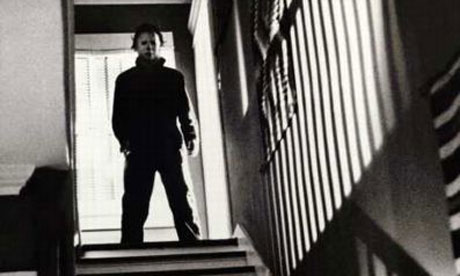
Halloween Movie Countdown #2: Halloween


 Fear can take many forms. In fact, fear is such an interesting topic because it can be very different for each person. In one of the most terrifying films of all time, fear takes the form of a masked killer. A relentless, chilling killer, one that knows no limits. Michael Myers will get you, it is that simple.

John Carpenter's 1978 film Halloween captures fear perfectly. The plot is simple; a masked man is attempting to kill you. I think it is safe to say that would bring fear to just about everyone. Laurie Strode, played by a young Jamie Lee Curtis, is living her life as normal, when, on Halloween, she continues to see a strange masked man. This masked man appears in several locations, including Strode's own backyard, where he is standing staring up into her window. Strode is concerned, but continues on with her plans, which include babysitting the neighbor's child for Halloween night. The masked man, revealed to be Michael Myers, continues to haunt Strode throughout the night, killing off her friends one at a time, before coming for her.

While the storyline is chilling enough as it is, Carpenter's product must be viewed in order to be fully appreciated. The film instills fear in the viewer, making them feel as if they are in the place of Strode. Jamie Lee Curtis does a phenomenal job in her first feature film portraying Strode. We are presented with a good, clean teenager, as opposed to her friends who can be seen engaging in appropriate behavior. We find ourselves "rooting for" Strode, to the point that we almost become her in the film. When Michael Myers comes after Strode, we really feel he is coming after us.

The fear of Michael Myers comes from two main things, both of which John Carpenter can be credited for. Halloween set the stage for the common horror film, both through it's general storyline and through it's scene style. Carpenter uses camera angles and atmosphere to portray horror and gore, rather than flat out showing it, as one might fin in a horror film of a more recent decade. Carpenter was able to create the right atmosphere in each scene, telling the audience what was happening without actually having to show it. This style of storytelling creates an even stronger sense of fear for the audience. By keeping Myers unexplained and undeveloped, Carpenter is able to create a figure that can be feared by all. Myers' appearance and characteristics create a horrifying figure, one that the viewer wants to stay away from, both physically and emotionally.


While the image of Michael Myers is terrifying enough, the music associated with him brings about it's own sense of fear. The score, composed and performed by Carpenter himself, is relatively simple, perhaps explaining why it is so perfect. The simple piano melody added to the image of Michael Myers slowly moving towards his victim will send chills down your spine.


Halloween captures the feeling of complete horror so perfectly. The audience is afraid of what will come next, where Michael Myers will be, what he will do. John Carpenter places the audience in the shoes of Myers' victims, and the audience, whether they realize it or not, fears for their own lives. Not only do they want Laurie Strode to get away, they don't want Michael Myers to get them. The film ends, the horror is over, yet the viewer is left with an utter sense of fear. Michael Myers is coming for you.

Monday, October 29, 2012

Halloween Movie Countdown #3: Signs


Do you want to know how I can tell this is 2012, not 2002? In 2002, this list (and many other sites' horror movie lists) would be comprised of 2-4 M. Night Shyamalan movies. Oh, back then, Shyamalan was getting all sorts of exciting new titles like The Next Spielberg or The New Master of Suspense. As anyone who really follows movies can tell you now, the man has yet to live up to either of those titles in the long run. I'm still hopeful that someday he'll come back to the land of quality filmmaking and pull of the biggest twist of his career by actually churning out wonderful films again. Until then, we've got four great gems to go back to. One of these gems, and certainly the scariest of them, is Signs.

Signs is not simply a gem of M. Night Shyamlan films, nor is it even a gem of any particular genre. It is a phenomenal movie that really pushes forward at all stops with fantastic writing, directing, and acting. This is a filmmaker at the top of his game crafting a smart, tender, and terrifying story. As far as I'm concerned, this is the best alien invasion movie of all time, perhaps the best of its sort of strange invasion genre. Shyamlan stated his influences for this film as The Birds, Invasion of the Body Snatchers, and Night of the Living Dead. So, that's what I mean by the "sort of strange invasion genre." It's not limited to alien invasions or zombies or birds, simply the plight of an ensemble of characters as an invasion threatens to destroy the world.

As for Signs, though, we are talking about an alien invasion. Our cast of characters is Graham Hess (Mel Gibson), a widower farmer in Pennsylvania who lives with his brother Merrill (Joaquin Phoenix) and his young son and daughter Morgan and Bo. Graham was a Reverend, but has lost his faith in anything other than raising his children and managing his farm since the death of his wife. Merrill was a famous baseball player whose life has been stalled as he lives with his brother, helping him raise the kids. When a pandemic of crop circles hits, signs are everywhere that this is not a prank; things will never be the same.

The absolute genius of Signs doesn't come from the aliens or the scares. It comes from the fascinating family drama and arc of a man struggling with the concept that the universe has meaning. In a scene, Graham tells Merrill the world is filled with two people:
"People break down into two groups. When they experience something lucky, group number one sees it as more than luck, more than coincidence. They see it as a sign, evidence that there is someone up there watching out for them. Group number two sees it as pure luck, just a happy turn of chance. I'm sure the people in group number two are looking at those fourteen lights in a very suspicious way. For them, the situation is a fifty-fifty. Could be bad, could be good, but deep down, they feel that, whatever happens, they're on their own and that fills them with fear. Yeah, there are those  people, but there's a whole lot of people in group number one. When they see those fourteen lights, they're looking at a miracle and deep down, they feel that, whatever's going to happen  there will be someone there to help them. That fills them with hope. See, what you have to ask yourself is what kind of person are you? Are you the kind that sees signs, that sees miracles? Or do you believe that people just get lucky? Or, look at the question this way: Is it possible there are no coincidences?"
Sure, it's a long quote, but a beautiful one. This right here is what Signs is really about. The alien invasion provides the setting for these kinds of questions the characters must confront. Mel Gibson absolutely nails it with this performance, creating a character trying to be cold and indifferent to the universe, but creating the emotional core of the film as he deals with everything falling apart around him. This film is really about a family dealing with the alien invasion, and that is why it is miles above the movies that even inspired Shyamalan to make it. The Birds may be a very original film, but I don't remember a thing about the characters in it. Don't even try to suggest that the Romero movies were really just character dramas set during the zombie apocalypse. They had satirical components, but this is a legitimate family drama, which makes it so much more compelling and ultimately terrifying when things start to really escalate.

The really scary films are the ones that instill a sense of fear because you genuinely don't want anything bad to happen to the main characters. Signs paints such a realistic portrayal of a family still trying to deal with the tragedy of the mother's death that you better believe you're scared when the thought of a gruesome death is put on the table. Yet, up until the climax, the threat is examined from the intimate perspective of these characters. We don't see aliens for quite sometime, not until Merrill sees one on the news. This scene alone is so wonderfully effective in just how realistic it ends up being, but it ends up being the point where fear really settles into your brain. This is the point when the hair on the back of your neck stands straight up. This is when you drop your jaw and clench your fists. This is beautiful cinema.

Sure, we can all say M. Night Shyamalan has a bad track record by now, but don't you ever dare suggest his Signs script was anything but immaculate. Every scene, every detail is completely relevant and fits together into the larger narrative with absolutely perfect ease. Knock The Happening all you want, then worship Signs. While the majority of films on this countdown have created a significant and lasting impact on the landscape of cinema, Signs (tragically) stands a lone masterpiece of its time. It captivated audiences a decade ago, but the filmmakers failed to take note, including the filmmaker who made it. Perhaps someday, we'll get another horror film as emotionally satisfying as Signs, but don't hold your breath. Gems like this are hard to find and even harder to get made.  Until then, why not watch the best?


Saturday, October 27, 2012

Halloween Movie Countdown #5: Alien


In space, no one can hear you scream

             Ridley Scott’s iconic blend of science fiction and horror, Alien, is most aptly summarized by this statement: In space, no one can hear you scream.  Alien, is a perfect mixture, a deep, psychological horror movie hidden underneath a façade of science fiction.  This is not to downplay the sci-fi elements or the sort of propositions that they entail but to explain how these elements enhance the horror movie that is at the core of this film.  A reflection of the situation in the film reveals that although Alien may not at first seem like a straightforward horror film, it works as a completely frightening movie because of all the different forms of fear found within it.  This is where the aspects of science fiction meet the more traditional horror aspects,

            The genre of science fiction, especially that which involves space and space travel, presents its own set of horrors and fears.  Space is not a hospitable place, and traveling through this vacuum, devoid of oxygen is, to put it very mildly, an extremely risky business.  Voyaging millions, even hundreds of millions of miles away from home and anyone that can offer aid in very much-uncharted expanses is spine tingling.  Should a vital piece of equipment malfunction, you are alone.  If foodstuffs run out, there is nowhere to go for food.  Isolation from loved ones and from news of loved ones is mentally taxing and breeds fear of their safety. 

The fear of the unknown is ever-present, and the possibilities of things that can go wrong are endless.  Even if such catastrophes do not occur and everyone back on Earth is safe and sound, the raw provocation that these events can occur is terrifying.  The fear of technology is very prevalent in science fiction, and in space travel one is entirely dependent on technology.  This plays a part in the film, with regards to the character Ash.  In space, you are essentially alone, save for your fellow crew.  The most underpinning of these fears is that fear of the unknown, of being completely ignorant of what exactly is out there.  This fear is very much realized by the crew of the Nostromo, as the nightmarish unknown becomes a lethal reality, segueing into the more conventional horror aspect of the movie: the alien.

The ghastly, murderous alien is the bridge into the underlying horror film within Alien.  This is also where Alien’s antagonist distinguishes itself from the usual suspects within horror.  When the creature bursts out of crew member Kane’s stomach, the movie takes a turn; this is the tipping point.  Up until this point, it was a brooding, psychological piece about these people, these workers whose routine journey had been delayed.  When looking at it that way, though, it does appear as though the movie sets up like a horror film.  Once the monster is loose, there is no question, as the movie descends into nightmarish, futuristic terror.  

The creature, itself, is an incredibly horrifying monster.  Strength, speed, and an aggressive intelligence combine to form a villain far more ghastly than Jason Vorhees chasing after scared teenagers in a hockey mask. This foe is very much invincible, and Ash describes him in a sick sort of way, “Pure.”  Ripley does not even directly kill it, only shoot it out into space, where it dies. 

            The technical aspects of the film lend it greatly to the horror realm.  The spaceship is dark, tight, and full of mystery.  Its vastness and little lighting present a perfect atmosphere for the creature to navigate and strike.  The noises of the machinery act as a second soundtrack, highlighting the cold, unforgiving nature of space and technology.  The soundtrack, proper, adds a great deal to this film.  At times brooding, dark, and ambient, and at other times full of sharp cacophony, it is the perfect soundtrack for a science fiction horror film.  All of these technical details peak perfectly during the climax of the movie, as Ripley combats the alien herself.

            Alien is such a perfectly crafted movie, and it works so well, accomplishing all of its goals.  Through the sci-fi elements of deep space travel and the concept of extra-terrestrial life, especially the mysterious imagery of the derelict spaceship and its skeleton pilot, the movie raises all those deep-seeded fears and philosophical questions.  Along with these aspects comes the pure horror driven plot involving the alien.  Throw in excellent effects, music, and emphatic performances, especially from Sigourney Weaver, and Alien is one of the most provocative horror movies of all time.  The actors and effects make the futuristic terror seem very real.  The prospect of a near perfect monster sealed on board my spaceship, hundreds upon hundreds of million miles away from home in the unforgiving vacuum of space not be the most immediate terrifying prospect out there, but in my opinion it is probably the most completely terrifying one that I have ever heard of, next to spiders. 

Thursday, October 25, 2012

Halloween Movie Countdown #7: Paranormal Activity

Are you surprised to see something so modern on this list? I suppose we've set a rather classic precedent thus far with Rosemary's Baby, Psycho, and The Omen. That being said, it's positively silly to think that all the good horror movies were made in previous decades. It's an easy mistake to make, though, in this barren wasteland of crappy horror films released anymore. Since M. Night Shyamalan fell off the map, in the early 2000s, Horror needed a new innovator to shape the genre for years to come. That innovator showed up in 2007 and rose to prominence in 2009. That man's name is Oren Peli and he wrote/directed Paranormal Activity.

Paranormal Activity was one of those independent gems that movie geeks like me hear about and follow even when the general audiences have no clue what it is. I remember reading about it for months, hearing how terrifying it was even though I'd never seen a trailer or anything. I believe it was late September or early October 2009 when it came to my local area. At the time, I was sitting at home with a minor back injury that left me uncomfortable, but capable of doing simple things, so I went to a movie. It was this. The general public's idea of the film is so different now that it's been sequelized and turned into a large mythology. There was none of that in 2009. There was simply the most effective use of found footage in a horror film and some genuinely great scares.

Is it possible that you don't know what this series is basically about? Well, if it is, let me explain it to you. Paranormal Activity is the tale of Micah and Katie, a relatively normal co-habitating couple. When Katie complains about strange sounds in the house, Micah takes the opportunity to go purchase expensive cameras and software because he's also a tech geek. (God, reading how dated this sounds already makes me feel really old). Since the only time the two aren't fully able to notice these sounds or weird happenings is when they aren't conscious, Micah sets up the camera to record them sleep, just in case they catch anything. It turns out they do catch quite a lot, and the scares begin.

As with any horror movie, you really should only know enough to get you hooked, then stay as far away from spoilers as possible. If there's one genre that's ruined by spoilers, it's the horror genre. As far as the pop culture obsession over this series goes, I'm not sure someone could watch this for the first time and not have some idea what kind of spoilers are in store, but that was really the beauty of the first one. It had such a creepy atmosphere that was presented in a way that was so fresh at the time. Now, found footage horror is more of a "Meh," reaction than anything. Can you believe that a film with its first wide release in 2009 is now vintage? I really can't.

This is far and away the scariest of the Paranormal Activity series and currently stands as a modern classic for the way it captured audiences and continues to years later. If you ask me, this is the movie Poltergeist dreamt of being. If you want to be afraid of your house, afraid of going to sleep, this is certainly that movie. Even more than that, while it becomes absolutely terrifying if you let it really sink into your brain, it's fun as hell. This film, and the subsequent sequels, found a perfect balance between scares and fun. Its characters are lose enough that they feel real nearly every time, and, though you know bad things are coming, you're excited for the activity to begin. The film becomes incredibly atmospheric as the nights progress and we slowly watch the activity wear on Katie and Micah's sanity and ultimately their relationship.

The really sad thing to take away here is how dated some of this is. I don't rewatch these movies, but upon reflecting on what a big deal it was that these characters decided to film themselves, it makes the way modern culture had adopted that process seem like it took way longer than it did. In this film, Micah is a weirdo for filming everything with his big clunky camera. By the time we get to the fourth film, it's not strange at all that a teenager would constantly be talking through a webcam or using her phone to see what the eyes don't let you see in the. It's an evolving series, but it all began here with the creepiest and best of the bunch. This is definitely a great Halloween movie, especially for those who turn the lights off and the sound off.


Wednesday, October 24, 2012

Halloween Movie Countdown #8: The Omen

Paired along with Rosemary's Baby, here we have all the material you'll ever need to instill fear of starting a family. Call it cinematic contraception. Does the above pictured little boy instill fear in you? Well, maybe he should and maybe he shouldn't. Most everyone, as a result of The Omen, will forever associate the name Damien with this youngster. In other words, most pop culture savvy parents will do their best to never name their boy Damien, probably with good reason.

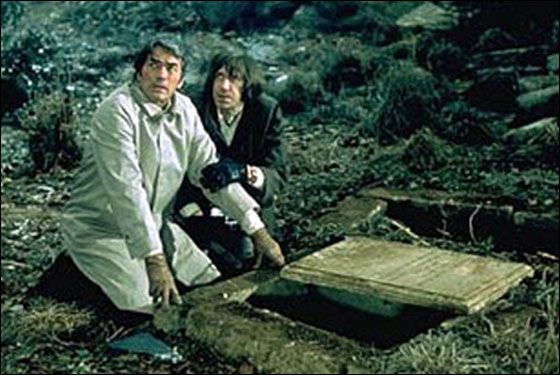
The Omen is the sum of many great parts. If one of these parts had not been up to snuff, this would simply have been one of those weird horror movies that no one cares about. The power of this film comes from Richard Donner's restrained but atmospheric direction, Jerry Goldsmith's goosebump inducing score, David Seltzer's original and creative script, and, most importantly of all, Gregory Peck's sympathetic and completely honest portrayal of a normal man going mad with signs that his son may represent all the evil of the world. Peck carries this film on his shoulders and makes every otherwise goofy situation scary and ultimately tragic. The Omen may be labeled as nothing more than one of the occult thrillers of the 70s, but it is so much more. Here, we have the most subtle apocalyptic movie of its era, a fascinating morality play, and the incredibly tragic tale of a once promising man.

Do I really even need to describe the plot to you? I'm sure everyone knows the gist of it. Gregory Peck plays Robert Thorn, a prominent American ambassador living in Britain with his wife and young son, Damien. The night of Damien's birth, Thorn was informed that his wife had birthed a stillborn, but that same night, another woman died in childbirth but there was a baby boy who was perfectly healthy. Making the morally questionable decision of switching the two babies so his wife would never know the awful truth, they go on to live their lives as any normal family would. As Damien gets older, strange things begin to happen and Thorn is approached by an old priest with ties to the hospital Damien was born in claiming the child is evil, the spawn of Satan, born to bring about the end of the world. Thorn refuses to accept this, but soon the signs become more and more telling and he must reconsider the situation and how he could possibly change things.

I'm not exactly the biggest Richard Donner fan out there. Unlike the rest of the world, I think those old Superman movies are pains to watch. Why couldn't he have made more movies like this? Here, he demonstrates a very controlled yet subtle tone, letting you discover the true nature of the situation no sooner than when Thorn himself does. The reveals are big, but the film is never playing with you. The genius of it all is how simple things end up being, yet how crazy the implications of such a scenario are. As stated above, I called this the most subtle apocalyptic movie of its era. You know, The Omen may be one of the most subtle apocalypse movies of all time. This is about the beginning of the end of everything. It's the rise of evil, but it's not even about that. All of that provides the wonderfully creepy backdrop for the tale of Thorn trying to figure out what the hell is going on.

Unlike Rosemary's Baby, The Omen presents a number of absolutely insane moral dilemmas. Just think about the basic implication of the film. What if your child, a seemingly normal youngster you've raised for five years now, is the manifestation of all evil? What would you do to stop it? Would you do anything? Could you do anything? These are the daily questions Robert Thorn has to face and the stakes only get raised higher and higher. There's no relenting once this film gets its pace going. Is it perfect? No. There are a few logical flaws with the screenplay, but I dare you not to have some internal reaction to the climax of this movie. It was created to get inside your skin and crawl all over. In this respect, The Omen is wonderfully done.

The Omen is not the film to watch for a lighthearted Halloween night, but it's definitely one worth seeing as far as creepy cinema is concerned. The last shot of the movie will leave you disturbed and ready for a good laugh. That's quality horror right there, right? Overwhelming and ultimately unstoppable evil makes for a wonderfully spooky watch. You may have been able to pray for Rosemary's baby, but this family is way past that already.


Tuesday, October 23, 2012

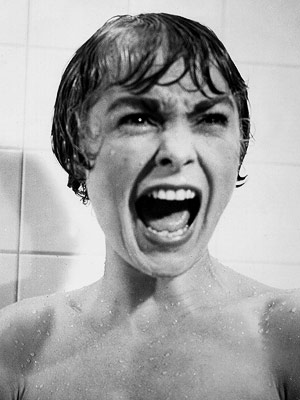
Halloween Movie Countdown #9: Psycho

One doesn't mention horror films without at least thinking of the great Alfred Hitchcock. The director was known for making audiences think, and when it came to horror films, making them fear. Hitchcock had the ability to take an everyday experience and make it scary. In what I believe is his greatest horror film, Hitchcock uses sound and imagery in such a perfect combination to create a tone of fear unlike any other. Psycho, based on the novel by Robert Bloch, is a classic horror film for both it's storyline and it's phenomenal imagery and sound.

The screenplay for Psycho was written by Joseph Stefano and was based on the novel Psycho by Robert Bloch. The story itself is incredibly well-written, taking the audience on a mental adventure and forcing them to think. The audience had no choice but to wonder. Numerous little twists cause the viewer to question their own thinking throughout the film. While the story was not his, Hitchcock did a wonderful job of keeping the viewer hooked while the story progressed. The suspense continually built throughout the film right up to the climax.

The story follows Marion Crane, a secretary from Phoenix running away with $40,000, to the Bates Motel. There, Crane meets Norman Bates, owner of the motel. Crane goes missing and friends and family are forced to find her themselves. Crane's boyfriend, Sam, sister, Lila, and private detective Arbogast head to the motel to see what they can find. They can't seem to get much help from the very strange Bates, who appears to be under the control of his sick mother. Mrs. Bates never leaves the house on the hill behind the motel, and Norman is often called to help her, leaving Sam and Lila alone with time to investigate. Eventually Lila meets Mrs. Bates, and discovers what is really going on at the Bates Motel.

The suspense is so great throughout the entire story, thanks to both Hitchcock's directing and the performance of the cast. While the entire cast was not what I would call outstanding, several actors delivered a perfect performance for this film. Anthony Perkins played the role of Norman Bates, and he could not have done much better. Perkins presents Bates as an awkward, over-eager motel owner, with a hint of creepiness. As the film progresses, so does the strangeness of Bates. Perkins did a fantastic job of putting himself in the shoes of his character, delivering a very real product. Anthony Perkins is, and always will be, Norman Bates.

Vera Miles also delivered a fantastic performance for what she needed to do. While it was not perfect, it was successful in creating the right character for the film. Miles plays Lila, the sister of Marion Crane. Miles is able to capture the idea of fright and horror perfectly towards the end of the film. In my opinion, that exact acting is what made the difference between this film being great, as opposed to good. Had Miles not pulled off the ultimate sense of fear and horror, Psycho would not be the film it is today.

Hitchcock uses sounds and imagery so perfectly in this film to set the tone and keep the audience hooked. The camera angles and shot selection create a feel of suspense throughout the story, and Hitchcock knows exactly what needs to happen and when it needs to happen. Perhaps even more crucial to the film than the imagery is the use of sound. The score for Psycho was written by Bernard Herrmann. The music was used so perfectly, creating the extreme feeling of suspense. It is my firm belief that the sound and music in Psycho are the most important aspects of the entire film. One cannot describe in words just how perfect the sound was, it must been experienced for oneself.


Psycho must be appreciated for what it is. It may not scare every viewer today, at least not the same way it did when it first came out. However, even for an older film, Psycho achieves a sense of fear and suspense in its viewers like none other.


Monday, October 22, 2012

Halloween Movie Countdown #10: Rosemary's Baby


Here we are, the scariest time of the year, 10 days away from Halloween. It's only fair to celebrate the way cinema has captured fear in our hearts and minds for these last ten days by counting down to Halloween. Expect some of the creepiest stuff to ever hit celluloid (or ugly digital camera memory cards) here. To start out, we have to return to the 1960s when paranoia cinema was just at its own height. This golden age of paranoid cinema hit its peak early with the Roman Polanski classic Rosemary's Baby.

This is classic horror storytelling at its finest. Rather than using fake scares, jumps, or even loud music, here we have a fantastically made character study of paranoia. What's so great about the film is how it's not even so much outlandish paranoia. We follow Rosemary Woodhouse, a housewife who has just moved into a new apartment with her actor husband. They are a happy couple hoping to have a baby. Rosemary becomes pregnant, but begins to be plagued by strange nightmares, and paranoia regarding her neighbors, her doctor, and her nosy neighbors. Is Rosemary just falling apart under the pressure of the pregnancy or is there validity to her fears - and what could be going on if she is right?

My advice on this film is simple - see it but read as little as possible about the plot. More than any other film, Rosemary's Baby is generally completely spoiled by every single plot description. It really bothers the hell out of me because part of the brilliance of this film is the journey of discovery or complete insanity we get to follow Rosemary on. This film gets every note right. Every single second of its runtime is completely devoted to telling you something, even if you don't exactly realize it.

Polanski creates a wonderfully controlled voice through the camera work and scene jumps, and it helps, of course, that he assembled a fantastic cast of Mia Farrow, John Cassavetes, Ruth Gordon, and Sydney Blackmer. It's this kind of perfectionist approach to horror that's more or less nonexistent in the modern cinematic landscape that really helps you buy into what you're seeing, because, this film completely relies on flawless acting to succeed. Succeed it does. This is the great mama of paranoia thrillers partially because of its subject matter. Together it combines two scary notions: pregnancy and insanity. Both are conditions that have a drastic outcome that you really have very little control over.

To take the concept of pregnancy, taught by most religions as a sacred and beautiful thing, and turn it into this disturbing and ultimately terrifying condition was really groundbreaking and oh so effective. You're pregnant and there are strange possibly occult things happening all around you. What if your neighbors, your doctor, and even your husband are actively working to harm your baby? Even worse than that, what if there's something terribly wrong with your baby already and you don't even know it? Of course, now that you've effectively cancelled out all notions of trust, you have to ask another question - what if none of this is true and you're just going crazy with paranoia? What implications does that have not only for your future, but for the child's?

If you love cinema, you really have no excuse not to give Rosemary's Baby your full attention for two and a half hours. It's not only completely worth it, but it will really get to you. Polanski's carefully constructed tone manages to illicit completely reasonable fear from the everyday details and yet also presents a very chilling satire on society, religion, and trust. Does that make Rosemary's Baby a complicated statement on existence? Well, no, not really. It is one hell of a fantastic horror film experience, however, and a classic you cannot let yourself ignore.

These are old school thrills, fantastic characters, and an ending you'll remember for quite some time. It may not be the scariest film out there, but it carries the capacity disturb you more psychologically than most films ever will. It's a great film and the highlight of Roman Polanski's mostly successful career. Get out there; see this movie and pray for Rosemary's baby.


Thursday, October 18, 2012

Seven Psychopaths: A Messy Tale About Writer's Block and Dognappers


I think I can speak for the majority of those interested in seeing Seven Psychopaths when I say writer/director Martin McDonagh set the bar extremely high with his debut In Bruges. In Bruges is just about as close to cinematic perfection as dark comedies get. It had a heart, it had a brain, and it was put together so well that you walked away very impressed. So, in the four years since, anticipation has been slowly growing higher and higher for McDonagh's sophomore effort. After all, he had proven his worth tenfold with a first film that's better than most directors can make in a lifetime.

Here it is, Seven Psychopaths, a well marketed comedy with a very impressive ensemble lined up. Colin Farrell returns to play Marty, a screenwriter struggling to finish writing his next film, having only a few ideas and the title Seven Psychopaths. His best friend Billy (Sam Rockwell) and Hans (Christopher Walken) run a scam by kidnapping dogs for rewards, but when they steal a gangster (Woody Harrelson)'s little dog, the ante is upped and the three must run for their lives. Marty begins to think that this opportunity has afforded him the perfect material for his gestating project, but he must first live through the ordeal to reap the rewards.

So, what we're really dealing with here is a very meta film created by a man who no doubt found himself in the exact same situation his aptly named protagonist is in. It was a great title, but McDonagh didn't want to write about violence, he wanted to write about peace. So, instead, he wrote about him not wanting to write about violence while writing about violent characters, some of whom just want peace. It may sound clever, but it's really just laziness if you ask me. Now, if this exact sort of approach to writer's block hadn't been already perfected ten years ago in the brilliant film Adaptation, you might be reading a completely different sort of review. Instead, this film finds itself in the shadow of its ultimately superior predecessor.

What makes this approach lazy now but brilliant ten years ago? you might ask. Well, McDonagh decided to drop all the subtlety or cohesiveness of his previous script and just go all out with being clever and silly here. The themes aren't really themes because a character just states that he wants them to be the themes. There's nothing clever about expressing your themes so bluntly, and then failing to even expand upon the already stated themes by actually saying anything. That's more or less the problem. This is a messy collection of ideas that ultimately adds up to nothing and has no point. It's not really making a statement about the process of screenwriting, nor does it go to uncharted territory. The plot really fails to hold up once you give it any thought, and no doubt it only falls apart even more upon repeat viewings.

This flaw goes even further when the self commentary splattered throughout the script turns into shrugging off obvious flaws in the writing by acknowledging, "Hey, yeah, I know that's a problem, but at least I'm being clever by mentioning it." For example, the female characters in this all get killed if not in their first scene, after the first couple. They have no bearing on the plot and the two lead female actresses exist purely as sex objects. This is a common feature in action films, and McDonagh has the Christopher Walken character make a wisecrack about how badly Marty writes women. Yeah, really funny considering it's true. That's no excuse for it, sorry. The greatest offense of this sort to be found here, however, is another Walken line where he is criticizing Marty for thinking psychopaths are all that interesting. We've got a bunch of one note characters who, by the end of the film, are really not that interesting once you get to know them, and yes, this is indeed a problem in the film that cannot simply be shrugged off by admitting that the writing fails to create anything more than one dimensional, disturbed characters.

Even more disappointing than the source of this material is the fact that a hell of a lot of it is actually really funny. In a way, this film is more like a series of vignettes and short films combined under the facade that it creates one cohesive whole. That being said, I'll be damned if the parts themselves don't have moments of brilliance. The impeccable casting lets the actors create a myriad of great moments between the characters. All of the comedic timing comes off great, only these characters ultimately don't have a whole lot to do, and none of them have any real depth. That's the self admitted problem with psychopaths; they're not terribly complicated. Giving these great moments to Christopher Walken, Sam Rockwell, Tom Waits, and Woody Harrelson is a wonderful thing, and I loved seeing these great actors up on the screen. It's only too bad that the sum of these funny parts adds up to a whole lot of nothing.

In the end, we are left with a very underwhelming, if entertaining movie about writing a movie. The cleverness of the concept stops exactly at the concept and, though Martin McDonagh is a very creative man, his unpolished experiment here is ultimately a failure. I wish I could say this is one of those great projects born out of writer's block like Adaptation or Barton Fink, but I just couldn't help but feel this needed a few more drafts or even an entirely different approach to actually become the memorable film it admits it wants to be.

6/10

Saturday, October 13, 2012

Sinister: The Scariest Movie of the Year

Can you believe it? Horror is back! It's been years since a movie this downright well done, emotionally gripping, and ultimately terrifying hit the cinemas. It's no secret that I really enjoy the Paranormal Activity series because they provide fun scares, but, let's face it, none of those really left you bothered after the first one. They're gimmicky but fun enough that you get over it. That's been what I look forward to in October since it seems the real scares don't exist anymore in the sea of mediocre horror remakes and retreads of the greats. You know what, though? Rest assured, Sinister brings back clever horror with a heart - and a bite.

Director/Co-Writer Scott Derrickson with C. Robert Cargill created the kind of original and spooky horror film that will (ideally) scar a generation of young teenagers for life. It's so well done not because there's a big scary bad guy or lots of gore. No, this is a well done movie for a very simple reason: intelligence. I credit a lot of the intelligence of the script to co-writer C. Robert Cargill, who was a critic for years over at Aint It Cool News. This guy has seen crappy horror and knows what mistakes to avoid. It's so refreshing to see a film that could so easily fall into every cliche in the book even given its own story which seems to lend itself to the same plot directions that have been used and reused for decades.

The plot follows Ellison Oswalt (played perfectly by Ethan Hawke), a true crime novelist far past his prime. It's been ten years since his last big hit and he's quickly falling into obscurity, but he has a plan to change this. In his last attempt to reach at that fame he used to achieve, Ellison has moved his family into a small town house of a murdered family where one of the children went missing. Most presumed the missing girl was long dead, but Ellison decides to do some further investigation and make a difference by solving the case and reaching old glory. As he investigates the murders, he is drawn further and further away from his wife and two children as he finds a box of old Super 8 footage reels in the attic that depict the murders of multiple families. Has he stumbled upon a serial murder that the police missed? Even more concerning, there are strange symbols and a shadowy figure in the images that cannot be overlooked, nor should they be.

Ultimately, this is a film that proves how unfortunate trailers are. It's a paradoxical predicament; seeing some of the movie makes you want to see more, but seeing more spoils things and make you wish you were seeing it completely fresh. It's best to forget the trailers as best as you can and simply let this film take you on its wild ride. Oh, and wild it is. Something especially clever about the film is how, in a year of so many found footage films that they no longer really make much of an impact, here we have the story of a man who manages to find terrifying footage. We get the same shock of seeing something that could be real, filmed by someone who is not a trained cinematographer, and it impacts the real story. There's no need for characters to film themselves because it becomes part of the plot itself.

Mark my words, there will not be a scarier movie released this year. With a film like this that hits all the right notes and leaves you disturbed and upset, I can't see another movie being more effective. We've got our latest installment of Paranormal Activity but that simply cannot capture the fresh fear Sinister harnessed so masterfully. Of course, a very significant difference between the two types of films is the character work. Both work because they actually craft characters, not cardboard cutouts or hot teens. Paranormal doesn't tend to strive to make you really care or root for its protagonists, however. It works well enough that you are scared silly when the action starts, but the deaths really aren't anything too depressing. (I'm looking at you, Micah). Sinister takes the opposite and ultimately more disturbing approach of crafting a cast of believable and innocent characters that you really don't want to die.

Ethan Hawke leads the family in a flawed but human performance that is very, very good. If the casting was off, this film could easily have turned silly instead of scary. He sees the deaths of all these old families and it's terribly disturbing. This film, while not overtly gory or ever going anywhere near the torture porn heights of the Saw franchise, is not for the faint of heart. You see a lot of innocent families get murdered and it's really not pleasant, but it serves the story and adds such a fantastically creepy atmosphere that you cannot help but see these and get sucked into the mystery just as much as the main character. When the stakes get raised, you're upset not simply because there is a weird noise, but because you cannot accept that harm could happen to this family. It's not okay, but it seems so likely.

This is a great horror movie. Plain and simple, this is horror done right. It's horrifying but not gratuitous. It treats the audience with intelligence and realizes how far it can take itself in any direction. There are real scares here, not simply jump scares. If you're looking for a great scary movie this October, you really don't need to look any further than Sinister. As for Paranormal Activity 4 coming out next week, well, I've had my serving of terror. Now, I'm ready for the icing on the cake.

8/10